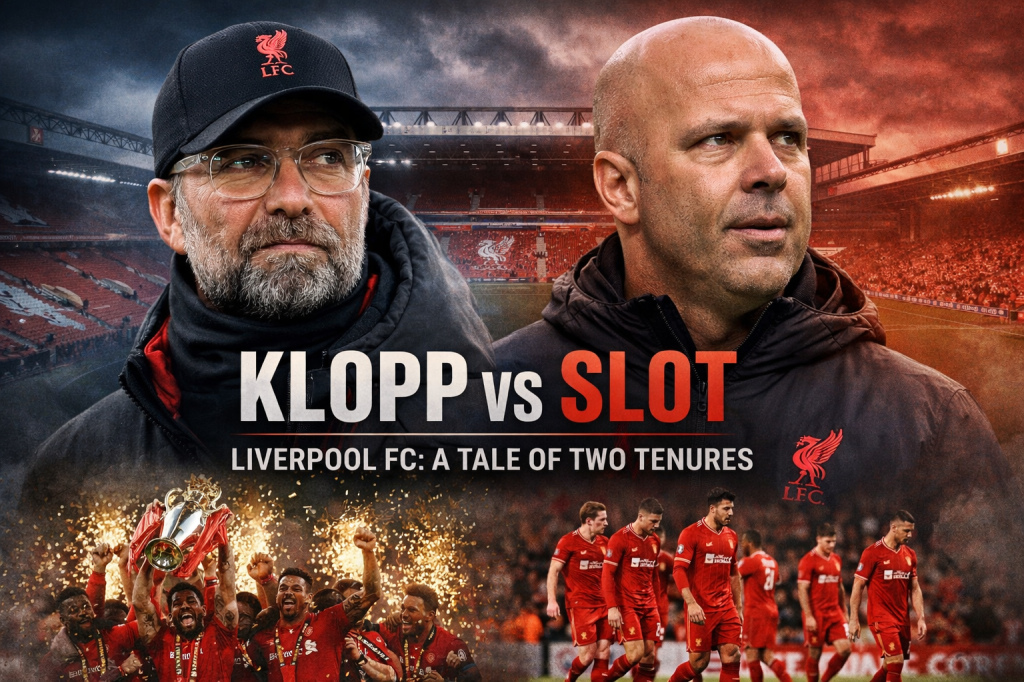
Comparisons between managers are an inevitable feature of elite football discourse, particularly when one long‑serving and transformative figure is succeeded by a new head coach. At Liverpool, the transition from Jürgen Klopp to Arne Slot has prompted frequent comparisons of results, style, and perceived effectiveness. However, direct comparisons risk oversimplification if they do not account for the differing conditions under which each manager operated.
This article assesses Liverpool’s on‑pitch performance under Klopp and Slot by placing results within their broader context. Rather than attempting to determine managerial superiority, the aim is to evaluate how outcomes were shaped by squad composition, financial flexibility, competitive environment, and the stage of each managerial cycle.
Jürgen Klopp: Early Tenure and Structural Rebuild (2015–2017)
Klopp assumed the Liverpool role midway through the 2015/16 season, inheriting a squad that had finished sixth the previous campaign and lacked both balance and consistency. His initial impact was less about immediate results and more about establishing a tactical identity based on intensity, pressing, and rapid transitions.
Liverpool finished eighth in the Premier League in 2015/16, while also reaching the finals of both the League Cup and the Europa League. These cup runs suggested progress in competitiveness, even if silverware ultimately proved elusive. The following season saw a league improvement to fourth place, securing Champions League qualification and indicating incremental progress rather than sudden transformation.
Recruitment during this period focused on reshaping the squad profile, with key additions such as Sadio Mané, Georginio Wijnaldum, and Joel Matip addressing pace, athleticism, and structural balance. The absence of major trophies during these seasons can reasonably be viewed as a reflection of Liverpool’s transitional status rather than managerial underperformance.
Klopp at Peak Performance (2019–2021)
By the 2019/20 season, Klopp’s Liverpool had reached tactical and squad maturity. Operating primarily in a 4‑3‑3 system, the team combined high‑intensity pressing with wide attacking output and consistent goal contribution from the forward line. The results were historic, with Liverpool securing the Premier League title alongside the UEFA Super Cup and FIFA Club World Cup.
Domestically, Liverpool recorded 32 league wins and remained unbeaten for the majority of the campaign, while European performance saw progression from the group stage before elimination in the knockout rounds. Importantly, this period coincided with relative squad stability, limited turnover, and continuity in key positions.
The 2020/21 season presented contrasting challenges. Despite strong attacking output, Liverpool finished third and failed to secure trophies. While European progress to the quarter‑finals suggested sustained competitiveness, domestic inconsistency pointed to the impact of squad availability and physical strain following previous high‑intensity campaigns.
Arne Slot: Immediate Impact and Inherited Conditions (2024–2025)
Arne Slot’s appointment followed the conclusion of Klopp’s tenure, with Liverpool transitioning away from a long‑established managerial identity. Slot inherited a squad that had recently achieved league success and retained several experienced, high‑performing players, most notably Mohamed Salah.
In his first season, Slot delivered immediate league success, securing the Premier League title by late April. Tactical adjustments were evident, with Liverpool frequently operating in a 4‑2‑3‑1 or 4‑1‑2‑3 shape, emphasising direct progression, forward runs beyond the defensive line, and structured support in wide areas.
While domestic cup competitions yielded earlier exits and the Champions League campaign ended in the round of sixteen, league consistency remained strong. With minimal transfer activity during this season, continuity played a significant role in maintaining performance levels.
Slot’s Second Season: An Ongoing Assessment (2025–2026)
Slot’s second campaign presents a different set of conditions to his debut season and remains ongoing. Significant squad turnover has taken place, with multiple first-team additions and departures across key positions. This level of structural change has coincided with fluctuating league form, with Liverpool currently positioned sixth following a mixed sequence of results.
In domestic cup competitions, progression has again been limited to this point, while Champions League performances indicate competitive capacity without consistent control across fixtures. A recent run of consecutive league defeats illustrates the volatility often associated with squad integration and tactical recalibration, rather than offering a definitive assessment of long-term direction.
At this stage of the season, conclusions must remain provisional. The available evidence reflects adaptation in progress, with results shaped by squad cohesion demands, evolving tactical application, and the broader competitive environment.
Direct Performance Comparison: Klopp and Slot in Their Initial Periods
To ensure a fair and proportionate comparison, it is instructive to assess Klopp and Slot only within equivalent early managerial timeframes. This approach avoids retrospective bias and limits evaluation to immediate results rather than long-term outcomes.
Jürgen Klopp (October 2015 – end of 2016/17):
- Premier League finishes: 8th (partial season), 4th
- League record across full 2016/17 season: 20 wins, 10 draws, 6 losses
- Cup competitions: League Cup finalist; Europa League finalist
- No major trophies secured during this period
Arne Slot (2024/25 – ongoing 2025/26):
- Premier League finishes: 1st (completed season), currently 6th (ongoing)
- League record in title-winning season: 25 wins, 9 draws, 4 losses
- Current league record (2025/26 to date): 10 wins, 6 draws, 7 losses
- Domestic cup competitions: League Cup finalist; FA Cup exits in early rounds
- One major trophy secured during initial period
From a purely results-based perspective, Slot’s early tenure has delivered higher immediate league outcomes, while Klopp’s initial period showed gradual league progression alongside deeper cup runs in European competition.
Key Variables Affecting Performance Comparisons
Several factors complicate direct comparisons between Klopp and Slot:
- Squad inheritance: Klopp began with a structurally imbalanced squad, while Slot inherited a title‑winning core.
- Squad turnover: Slot’s second season involved extensive personnel changes, contrasting with Klopp’s peak years of stability.
- Financial flexibility: Transfer activity differed significantly across periods, affecting immediate expectations.
- Psychological context: The emotional transition following Klopp’s departure may have influenced early perceptions and pressures.
- League competitiveness: Title thresholds and overall league strength varied across seasons.
Acknowledging these variables is essential to avoid reductive conclusions.
Conclusion
Comparing Jürgen Klopp and Arne Slot through the lens of performance reveals less about managerial quality in isolation and more about the conditions under which each operated. Klopp’s early years reflected structural rebuilding, his peak coincided with stability and continuity, and his later seasons showed the strain of sustained intensity. Slot’s tenure, by contrast, began with immediate success before entering a period of recalibration amid significant squad change.
At this stage, any definitive judgement on Slot’s long‑term impact would be premature. A more balanced reading suggests that Liverpool’s results under both managers are best understood as products of timing, structure, and context rather than direct reflections of comparative managerial capability.

 CWM Media
Leave a comment